
Why Is Your Air Conditioner Not Cooling?
Few things are more frustrating than an air conditioner running flat out on a 38-degree Australian summer day and still not cooling the room. The unit sounds like it's working, the fan is blowing, but the air coming out is barely cold. If your air conditioner is not cooling properly, the cause is usually one of a handful of common problems, most of which you can diagnose yourself before calling a technician.
This article walks through the six most likely culprits: a dirty or clogged air filter, incorrect thermostat settings, ice buildup on the indoor coil, a blocked outdoor condenser unit, low refrigerant from a leak and a unit that's simply too small for the space it's trying to cool. Start with the simple checks first and work your way down the list.
Key takeaways
- Most air conditioner not cooling issues stem from dirty filters, wrong settings or blocked outdoor units.
- Refrigerant leaks and compressor faults require a licensed technician and cannot be fixed at home.
- Regular filter cleaning and outdoor unit maintenance prevent the majority of cooling problems.
The Most Common Reasons an Air Conditioner Stops Cooling
An air conditioner that runs but won't cool is almost always caused by one of six issues: restricted airflow, incorrect settings, a frozen coil, a dirty outdoor unit, a refrigerant leak or a unit that's undersized for the room. Most of these can be identified with a quick visual check before you pick up the phone to book a service call.
Dirty or Clogged Air Filter
The air filter sits inside your indoor unit and catches dust, pet hair and airborne particles before they reach the evaporator coil. When the filter gets clogged, airflow over the coil drops sharply. Without enough warm air passing over it, the coil can't transfer heat effectively and the unit blows air that feels barely cool, even though the compressor is running normally.
Filters should be cleaned every four to six weeks during periods of heavy use, and at least once every three months in milder seasons. It takes about five minutes and costs nothing. If you're not sure how to do it safely, our guide on how to clean your air conditioner at home covers the full process step by step.
Thermostat Set to Fan-Only Mode
Fan mode circulates air around the room without switching on the compressor, which means no refrigerant cycle and no actual cooling. If your unit is blowing air but it's not cold, check the remote first. Make sure the mode is set to 'Cool' (usually shown as a snowflake icon) rather than 'Fan' (a fan blade icon), and confirm the set temperature is at least two or three degrees below the current room temperature.
Remote symbol confusion is one of the most common reasons people think their aircon has stopped working. A quick check of the mode setting takes 10 seconds and fixes the problem more often than you'd expect.
Ice Buildup on the Indoor Coil
If airflow is restricted for long enough, or if refrigerant levels drop too low, the evaporator coil can drop below freezing and ice over completely. A frozen coil blocks cold air from reaching the room and can cause the unit to blow warm air or stop airflow almost entirely. You may notice ice visible around the indoor unit or on the copper pipes running to the outdoor unit.
To fix it, turn the unit off and switch to fan-only mode for one to two hours to let the coil defrost naturally. Do not chip at the ice. Once defrosted, clean the filter before restarting. If the coil freezes again quickly, the underlying cause (a dirty filter or a refrigerant issue) still needs to be addressed.
Blocked or Dirty Outdoor Condenser Unit
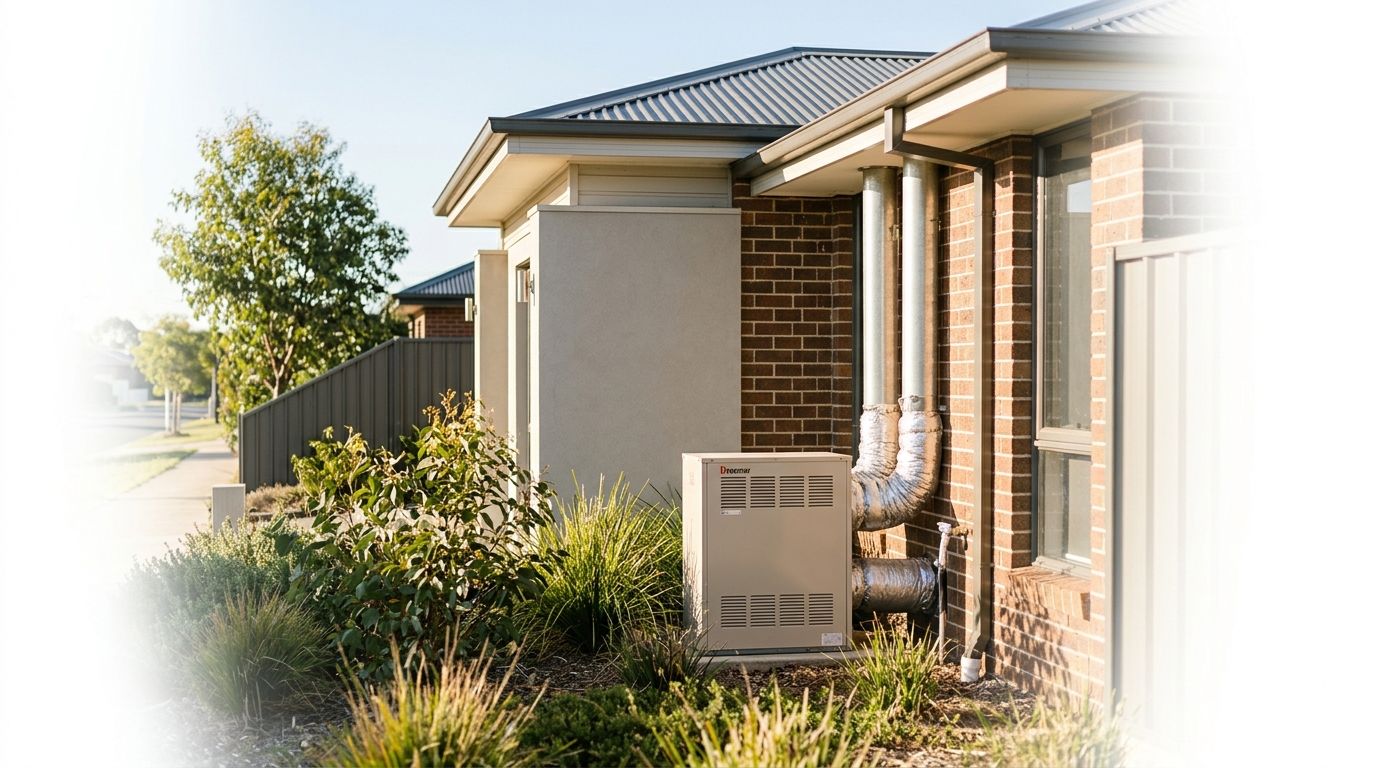
The outdoor unit expels the heat extracted from your home into the outside air. To do that efficiently, it needs clear airflow on all sides. Overgrown shrubs, garden debris, a fence built too close or a thick layer of dirt and grime on the condenser fins all force the compressor to work harder and reduce cooling output significantly.
Check that there's at least 50cm of clear space around the outdoor unit and that nothing is sitting on top of it. If the fins look visibly dirty, a gentle rinse with a garden hose (with the unit switched off at the isolator) can help restore airflow. Avoid using a high-pressure washer, as this can bend the delicate aluminium fins.
Low Refrigerant or a Refrigerant Leak
Refrigerant is the substance that actually moves heat out of your home. Unlike petrol in a car, it doesn't get consumed during normal operation. If refrigerant levels are low, it means there's a leak somewhere in the system. Common signs include a hissing or bubbling sound near the indoor or outdoor unit, ice forming on the copper pipes and the unit blowing air that's lukewarm rather than cold.
This is not a DIY fix. Handling refrigerant requires an EPA-licensed refrigeration technician, and topping up the gas without finding and repairing the leak first is a waste of money. Read our full guide to aircon regas to understand what the process involves, what it costs and when it's worth doing versus replacing the unit.
Unit Undersized for the Room
An air conditioner that's too small for the space it's cooling will run continuously without ever reaching the set temperature. This isn't a fault or a sign that something has broken. It's a permanent performance limitation. A 2.5kW unit in a 30-square-metre room with poor insulation and a north-facing window will simply never keep up on a hot day, no matter how well it's maintained.
If your unit runs all day and the room stays stubbornly warm, sizing is likely the issue. Check our room-by-room sizing guide to see what capacity is actually needed for your space, factoring in ceiling height, insulation, sun exposure and climate zone.

How to Fix an Air Conditioner Not Cooling: Step-by-Step
Before calling a technician, work through this checklist in order. Most air conditioner cooling problems can be traced back to a simple setting, a dirty filter or a blocked outdoor unit. Start at step one and only move to the next step if the problem persists after each fix.
- Check the remote settings. Confirm the mode is set to 'Cool' (the snowflake icon) and not 'Fan' or 'Dry'. Then check that the set temperature is at least two to three degrees below the current room temperature. If the room is 27°C and the thermostat is set to 26°C, the unit has almost no reason to run the compressor hard.
- Check and clean the air filter. Open the front panel of the indoor unit and remove the filter. If it's visibly grey or clogged with dust, rinse it under lukewarm water, let it dry fully and reinstall it. A blocked filter is the single most common cause of poor cooling performance.
- Check the outdoor unit for obstructions. Walk outside and look at the condenser unit. Clear away any leaves, grass clippings or debris from around the unit. Make sure there's at least 50cm of clear space on all sides and that nothing is sitting on top of it.
- Defrost a frozen coil. If you noticed ice on the indoor unit or copper pipes, turn the unit off completely and switch to fan-only mode for one to two hours. Do not chip at the ice. Once defrosted, clean the filter before restarting in Cool mode.
- Reset the unit at the circuit breaker. Switch the breaker off, wait a full three minutes, then switch it back on. This clears any fault codes or error states the unit may have locked into. Restart the unit normally and test cooling again.
- Call a licensed technician. If none of the above steps restore cooling, the problem is most likely a refrigerant leak, a failing compressor or an electrical fault inside the unit. These faults require a licensed refrigeration technician and cannot be safely diagnosed or repaired at home.
When to Call a Professional and When to Consider a New Unit
Some air conditioner faults need a licensed technician regardless of how handy you are. Others point to a unit that's simply reached the end of its useful life, where paying for a repair makes less financial sense than replacing it with a more efficient model.
Faults That Always Need a Licensed Technician
Three types of faults should never be treated as DIY jobs. Refrigerant leaks require an EPA-licensed refrigeration mechanic to locate the leak, repair it and recharge the system. Compressor failure is a major mechanical repair that typically costs $800 to $1,500 or more in parts and labour. Electrical faults inside the unit, including failed control boards and wiring issues, carry a real safety risk and must be handled by a qualified technician.
If your unit is displaying an error code, making grinding or hissing noises or tripping the circuit breaker repeatedly, stop running it and book a service call. Continuing to run a unit with an active fault can turn a repairable problem into a write-off.
The Repair vs Replace Decision
A useful rule of thumb: if your unit is over 10 years old and facing a repair that costs more than half the price of a new unit, replacement is almost always the better financial decision. Older units also run on refrigerants that are being phased out, and their energy efficiency ratings are well below what modern inverter systems deliver.
A new 3.5kW inverter split system can be had for well under $1,300. The Daikin 3.5kW Lite Inverter Split System (FTXF35WVMA) is $1,177 and is one of the most reliable entry-level units on the market. The Mitsubishi Electric 3.5kW AP Series (MSZ-AP35VGKD) comes in at $1,229 and adds a slightly higher energy star rating along with Mitsubishi Electric's reputation for long-term reliability. Either unit will outperform a 10-year-old system on both cooling output and running costs from day one.
If you're weighing up your options, browse our full range of split system air conditioners to compare models, capacities and prices across all major brands.
Keeping Your Aircon Cooling Properly: Maintenance Tips
A well-maintained inverter split system should cool efficiently for 10 to 15 years with minimal fuss. The key is building a few simple habits around filter cleaning, outdoor unit clearance and annual servicing, rather than waiting for a problem to appear before giving the unit any attention.
Filter cleaning is the single most impactful thing you can do. During summer, aim to clean the filter every four to six weeks. It takes five minutes, costs nothing and prevents the most common cause of poor cooling performance. Outside of peak season, once every two to three months is usually enough.
The outdoor unit needs breathing room to do its job. Keep at least 30cm of clear space around all sides of the unit and trim back any shrubs or garden growth that creeps toward it. Clear away leaves, grass clippings and debris after storms or mowing. A blocked condenser works harder, runs hotter and wears out faster.
- Clean the air filter every four to six weeks during summer
- Keep at least 30cm of clear space around the outdoor unit
- Book a professional service once a year, ideally before summer starts
- Make sure indoor vents are not blocked by furniture, curtains or shelving
An annual professional service covers the things you can't easily check yourself: refrigerant pressure, electrical connections, coil condition and drain line health. Booking in spring means any issues get caught before the first hot spell of the season.
If you're looking for a unit that rewards this kind of straightforward care, the Daikin 3.5kW Cora Inverter Split System (FTXV35WVMA, $1,256) is a good example. It has a self-cleaning function that helps keep the indoor coil in good condition between services, which makes the maintenance routine even simpler.
Frequently Asked Questions
How to fix an aircon that is not cooling?
Start by checking that the remote is set to 'Cool' mode with the temperature set at least two to three degrees below the current room temperature. Then clean the air filter and check the outdoor unit for any blockages or debris. If you can see ice on the indoor coil or copper pipes, turn the unit off and run fan-only mode for one to two hours to let it defrost. If none of these steps restore cooling, call a licensed technician to check the refrigerant level and compressor.
How do I reset my central AC not blowing cold air?
Turn the unit off at the remote or wall controller, then switch it off at the circuit breaker. Wait at least three minutes before switching the breaker back on and restarting the unit. This wait time is sometimes called the '3-minute rule' and allows refrigerant pressure to equalise before the compressor starts again. If the problem persists after a reset, check the display for a fault code or a flashing indicator light, as these usually point to the specific issue.
Is AC good for BP patients?
Air conditioning can be beneficial for people with high blood pressure because it reduces heat stress, which can cause blood pressure to spike during hot weather. However, very cold settings or sudden shifts between hot outdoor air and a cold room may cause blood vessels to constrict, which can also affect blood pressure. A moderate, consistent temperature around 22 to 24°C is generally considered comfortable and less likely to cause sudden changes. Always consult your doctor for personal medical advice.
What is the 3 minute rule for air conditioners?
The 3-minute rule means waiting at least three minutes after turning an air conditioner off before switching it back on. This pause allows the refrigerant pressure in the system to equalise, so the compressor does not have to start against a high-pressure load. Skipping this wait can cause the compressor to trip on its overload protector or, over time, cause premature wear. Most modern units have a built-in time-delay protection that enforces this automatically, but it is still good practice to wait when doing a manual reset at the circuit breaker.
Still Not Cooling? Browse Reliable Replacements
Most air conditioner cooling problems come down to a dirty filter, a wrong thermostat setting or a blocked outdoor unit. All three are fixable at home in under 30 minutes. For refrigerant leaks, compressor faults or a unit that's simply too old to justify the repair bill, a professional service or a full replacement is the smarter call.
Modern inverter split systems are more efficient, quieter and more reliable than the units they replace. If your aircon is over 10 years old and struggling to keep up, the running cost savings alone can offset the price of a new unit within a few seasons. Browse our best-selling air conditioners to compare trusted brands, capacities and prices and find the right unit for your home.