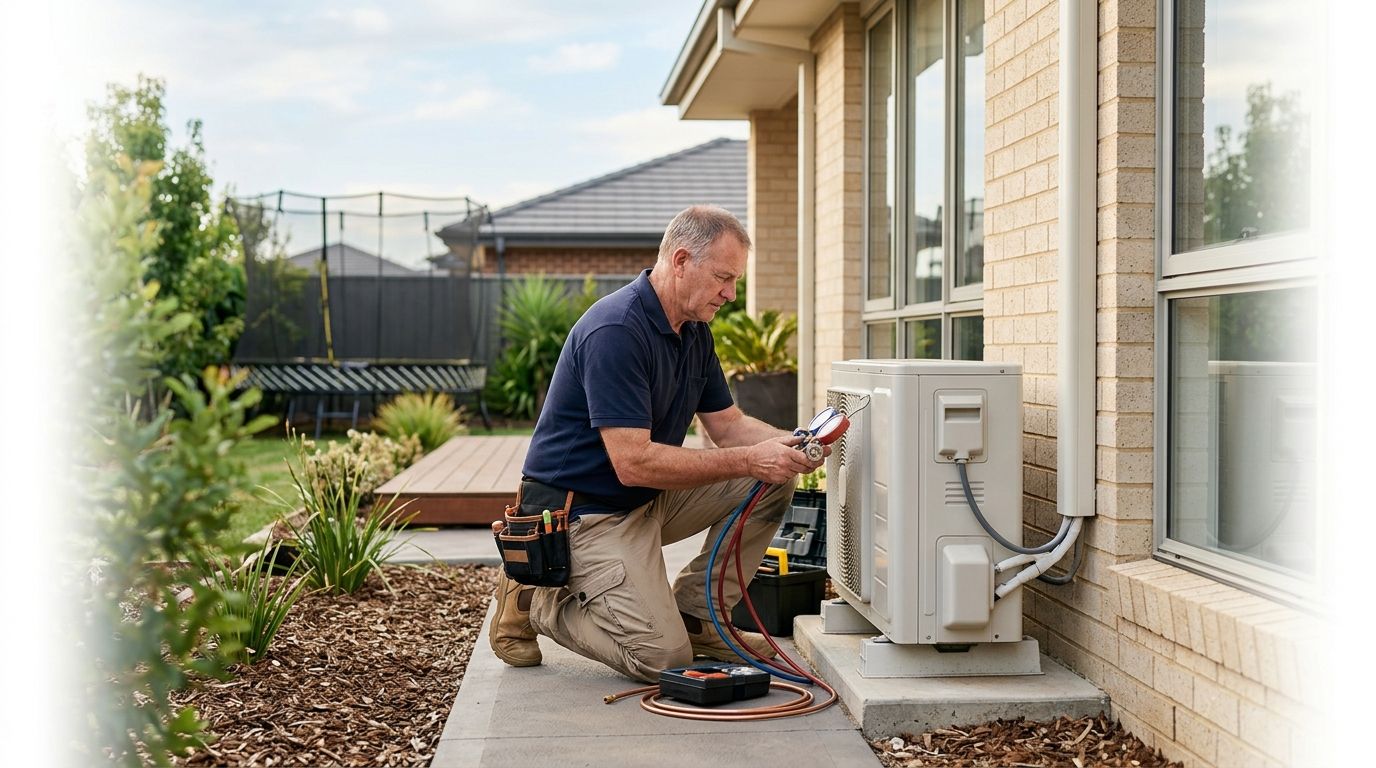

What Is an Aircon Regas?
An aircon regas is the process of removing old or depleted refrigerant from your air conditioning system and recharging it with a fresh supply. Refrigerant is the substance that makes cooling (and heating, in reverse-cycle systems) physically possible. It circulates between the indoor and outdoor units, absorbing heat from the air inside your home and releasing it outside.
Unlike a car's air conditioning system, a home split system is a sealed loop. Refrigerant is not consumed or burned off during normal operation, so the gas level should stay constant for the life of the unit. If levels are low, it almost always means there is a leak somewhere in the system.
That distinction matters. A regas without finding and fixing the underlying leak is a short-term fix at best. The gas will simply escape again, and you will be back to square one within months. This article walks you through the real signs that a regas is needed, what the job typically costs across Australia, and how to decide whether repairing an older unit still makes financial sense.
Signs Your Air Conditioner Needs a Regas
Low refrigerant does not announce itself with a warning light or error code on most residential units. Instead, you notice the system behaving strangely over days or weeks. The symptoms below are the most common indicators, but none of them are exclusive to a refrigerant problem. A dirty filter, a failing compressor or a blocked condenser coil can produce very similar results. Always have a licensed refrigeration technician diagnose the fault before committing to a regas.
Warm Air and Poor Cooling Performance
Refrigerant absorbs heat by evaporating inside the indoor unit's coil. When there is not enough of it, the coil cannot absorb sufficient heat from the room air, and the air blowing out of the vents feels lukewarm even with the thermostat set to 18 or 19 degrees. This is usually the first thing homeowners notice, and it tends to get progressively worse as the leak continues.
You might also find the system runs for much longer than usual without the room ever reaching the set temperature. On a 35-degree summer day in Brisbane or Western Sydney, a healthy split system should cool a correctly sized room within 20 to 30 minutes. If it is still struggling after an hour, low refrigerant is one of the first things a technician will check. That said, an undersized unit or a poorly insulated room can produce the same result, so context matters.
Ice Build-Up on the Unit
This one surprises a lot of people. Low refrigerant causes the pressure inside the evaporator coil to drop, which makes the coil surface temperature fall well below freezing. Moisture in the air then freezes on contact with the coil, and you end up with visible ice forming on the indoor unit or along the refrigerant lines running to the outdoor unit.
If you spot ice, switch the system off immediately and let it thaw before calling a technician. Continuing to run the unit in this state forces the compressor to work against a blocked coil, which can cause serious and expensive compressor damage. A compressor replacement on a residential split system can cost $800 to $1,500 or more, so catching ice build-up early is worth the inconvenience of a few hours without cooling.
Other symptoms worth watching for include a hissing or bubbling sound near the refrigerant lines, which is a strong indicator of an active leak, and a noticeable rise in your electricity bills without any change in how you are using the system. Both are worth mentioning to your technician when you book the service call.

How Much Does an Aircon Regas Cost in Australia?
For a standard residential split system, expect to pay somewhere between $200 and $400 for a regas. That price typically covers the refrigerant itself, a leak check and the technician's labour. Costs vary depending on where you live, with metro areas in Sydney and Melbourne generally sitting at the higher end of that range compared to regional Queensland or South Australia.
If the technician finds a leak and needs to repair it before recharging the system, the total bill can climb to $400 to $800 or more. The repair complexity matters a lot here. A straightforward valve or fitting fix is relatively affordable, but a crack in the evaporator coil or a damaged refrigerant line can push costs significantly higher. Always ask for a written quote that separates the leak repair from the regas itself so you know exactly what you are paying for.
Two practical tips before you book. Get at least two quotes from different technicians, and confirm that whoever you hire holds a current ARCtick licence. Handling refrigerant without an ARCtick licence is illegal in Australia, so this is a non-negotiable check rather than just a nice-to-have.
Refrigerant Types and How They Affect Price
The type of refrigerant in your system is one of the biggest factors in what a regas will cost. There are three types you are likely to encounter in Australian homes.
- R22: An older refrigerant that has been phased out under Australia's obligations to the Montreal Protocol. R22 is now scarce and expensive, and a regas on an R22 system can cost two to three times more than a modern equivalent. Many technicians will recommend replacing an R22 unit outright rather than regassing it, which is often the more sensible financial call.
- R410A: The standard refrigerant in split systems sold throughout the 2000s and 2010s. Still widely available and reasonably priced, though it is gradually being superseded.
- R32: The current standard in most new split system air conditioners sold in Australia today. R32 has a lower global warming potential than R410A and is generally cheaper to source, which keeps regas costs at the lower end of the typical range.
If you are unsure which refrigerant your system uses, check the label on the outdoor unit. It will be printed clearly alongside the system's model number. Knowing this before you call a technician means you can get a more accurate quote upfront.
Regas or Replace? How to Decide
A regas costing $250 to $350 is easy to justify on a system that is three or four years old and has developed a one-off leak. The maths gets murkier as the unit ages or the faults start repeating. Here is how to think through the decision.
Age of the unit. A well-maintained split system should last 10 to 15 years. If yours is already past the 10-year mark, spending $400 or more on a regas and leak repair means you are putting significant money into a system that may need a compressor or PCB board replacement within the next few years anyway. At that point, replacement starts to look like the smarter investment.
Whether a leak was found. A single leak on an otherwise healthy system is not a reason to panic. Fittings can work loose, and a one-off repair is perfectly reasonable. But if this is the second or third time you have had a technician out for low refrigerant, the system has an ongoing problem. Repeated regas jobs add up fast, and you are not solving the root cause.
The cost of a new unit relative to the repair bill. This is where the numbers get concrete. An entry-level Daikin 2kW Cora Inverter Split System (FTXV20WVMA) retails for $982. The Fujitsu 2.5kW Lifestyle Range Inverter Split System (ASTG09KMTC) comes in at $1,014, and the Fujitsu 3.5kW Lifestyle Range Inverter Split System (ASTG12KMTC) is $1,190 for a slightly larger room. If your regas and leak repair quote is sitting at $600 to $800 on a 12-year-old system, a new unit with a full manufacturer's warranty and significantly better energy efficiency is not far out of reach. You can browse our Daikin range to see current models and pricing.
Energy efficiency gains. Modern inverter systems are considerably more efficient than units made a decade ago. A new R32 split system with a high star rating will cost less to run every year, which offsets part of the purchase price over time. That ongoing saving is worth factoring into your decision, not just the upfront repair versus replacement cost.
As a general rule, if the system is under five years old and the leak is a one-off, a regas is almost always the right call. If it is older, repeatedly faulty or running on R22, replacement deserves serious consideration. Compare current prices on best-selling air conditioners to get a realistic sense of what a new unit would set you back before you commit to a costly repair.
What to Expect From the Regas Process
A professional aircon regas follows a clear sequence of steps, and understanding what happens on the day helps you know whether the technician is doing the job properly. For a standard residential split system, the whole process typically takes one to two hours from start to finish.
The technician will start by connecting pressure gauges to the system's service ports to check the refrigerant pressure against the manufacturer's specifications. Low pressure confirms the system is undercharged, and the readings also give clues about where a leak might be. From there, they will inspect the refrigerant lines, fittings, valves and coils for signs of a leak, often using an electronic leak detector or UV dye.
Before any new refrigerant goes in, the remaining gas must be recovered using certified recovery equipment. This is a legal requirement under Australian regulations. Venting refrigerant directly to the atmosphere is a criminal offence, regardless of the type or quantity involved.
Once any leak has been repaired and the system has been evacuated and checked for moisture, the technician recharges it to the exact level specified by the manufacturer. Overcharging is just as damaging as undercharging, so this step requires precision. A final performance test confirms the system is cooling correctly before the job is signed off.
Handling refrigerant without a current ARCtick licence is illegal in Australia. This is not a job for a general handyman or a DIY fix found online. Always verify your technician's ARCtick accreditation before they start work.
Keep Your System Running at Its Best
Aircon regas is not something you schedule as part of routine maintenance. It is a fix for a specific problem, almost always caused by a refrigerant leak. If your system is cooling poorly, icing up or running your electricity bill higher than usual, a licensed ARCtick technician is your first call. Budget $200 to $400 for a straightforward regas, and more if a leak repair is involved.
For systems that are ageing, running on R22 or developing leaks repeatedly, replacement is often the more sensible path. A new inverter split system with a full manufacturer's warranty and better energy efficiency can cost less than you might expect, and it removes the uncertainty of ongoing repair bills.
If a new unit is on your radar, browse our full range of split system air conditioners to compare current models and pricing across all the major brands.
Frequently Asked Questions
How much does it cost to regas my aircon?
Most Australian households pay between $200 and $400 to regas a residential split system, and that price typically covers the labour, a leak check and the refrigerant top-up. If the technician finds and repairs a leak during the same visit, expect the total to climb higher. Older systems running R22 refrigerant also cost more, because R22 has been phased out in Australia and the remaining supply is scarce and expensive.
How long should an aircon regas last?
A properly sealed system should hold its refrigerant charge for the entire life of the unit. There is no set interval for regassing. It is not a routine maintenance item like a filter clean. If your system needs another top-up within a few years of the last one, that is a strong sign there is an unresolved leak somewhere in the system. Topping it up again without fixing the leak is just money down the drain.