
Can You Really Install a Split System Aircon Yourself?
If you've just bought a split system aircon and you're staring at the installation manual thinking "how hard can it be?", you're not alone. The DIY temptation is real, especially when professional installation quotes can add hundreds of dollars to the total cost. But split system aircon installation in Australia is not a straightforward DIY job, and the reasons go well beyond just the technical complexity.
This article covers exactly what the installation process involves, what Australian law actually says about who can do what, which parts a homeowner can legally handle themselves, and how to find a qualified installer who won't overcharge you. No scaremongering, just the facts you need to make a smart decision.
Key takeaways
- You cannot legally install a split system aircon yourself in Australia without an ARC licence and electrical qualifications.
- Refrigerant handling and electrical connections are restricted to licensed tradespeople by federal and state law.
- Homeowners can only handle preparatory tasks like choosing locations and clearing work areas.
- Unlicensed installation voids your manufacturer warranty and may invalidate your home insurance.
The Legal Reality: What Australian Law Says About DIY Aircon Installation
In Australia, split system installation is not fully legal as a DIY project for most homeowners. Three separate areas of law apply, and understanding each one will save you from a costly mistake.
Refrigerant Handling Requires a Licence
The biggest legal barrier is refrigerant. Modern split systems use refrigerants like R32 or R410A, and under Australian law, only a person holding an ARC (Refrigerant Handling Licence) issued by the Australian Refrigeration Council can legally handle these substances. This covers recovering, recharging, transferring or disposing of refrigerant. Doing any of this without a licence is a criminal offence under the Ozone Protection and Synthetic Greenhouse Gas Management Act, and fines can be substantial.
This is not a technicality that gets overlooked. Refrigerant handling is tightly regulated because these gases are potent greenhouse gases when released into the atmosphere. For readers who want to understand exactly what an ARC licence is and why your installer needs one, we've covered it in detail in a dedicated guide.
Electrical Work Must Be Done by a Licensed Electrician
Connecting the indoor and outdoor units to your home's switchboard is electrical work, and in every Australian state and territory, electrical work must be performed by a licensed electrician. This includes running the dedicated circuit, installing the isolator switch near the outdoor unit and making the final connections. Unlicensed electrical work is illegal regardless of how competent you feel, and it will void your home insurance if something goes wrong.
What a Homeowner Can Legally Do
The one area where a competent DIYer can legally get involved is structural preparation. Drilling the wall penetration hole, mounting the indoor unit bracket and positioning the outdoor unit on a flat surface are not licensed trades in most states. That said, most professional installers include this work as part of a standard installation quote, so there is rarely a meaningful cost saving in doing it yourself.
Warranty Implications
Beyond the legal issues, unlicensed installation almost always voids the manufacturer's warranty. Daikin, Mitsubishi Electric, Fujitsu and every other major brand require installation by a qualified technician as a condition of their warranty. If your unit develops a fault six months after a DIY install, you will likely be paying for the repair out of pocket regardless of what caused the problem.
The bottom line is that the refrigerant and electrical requirements alone make full DIY installation illegal for the vast majority of Australian homeowners. The structural prep work is the only legal grey area, and it is rarely worth separating from the rest of the job.

How to Install a Split System Aircon: A Step-by-Step Look at What's Involved
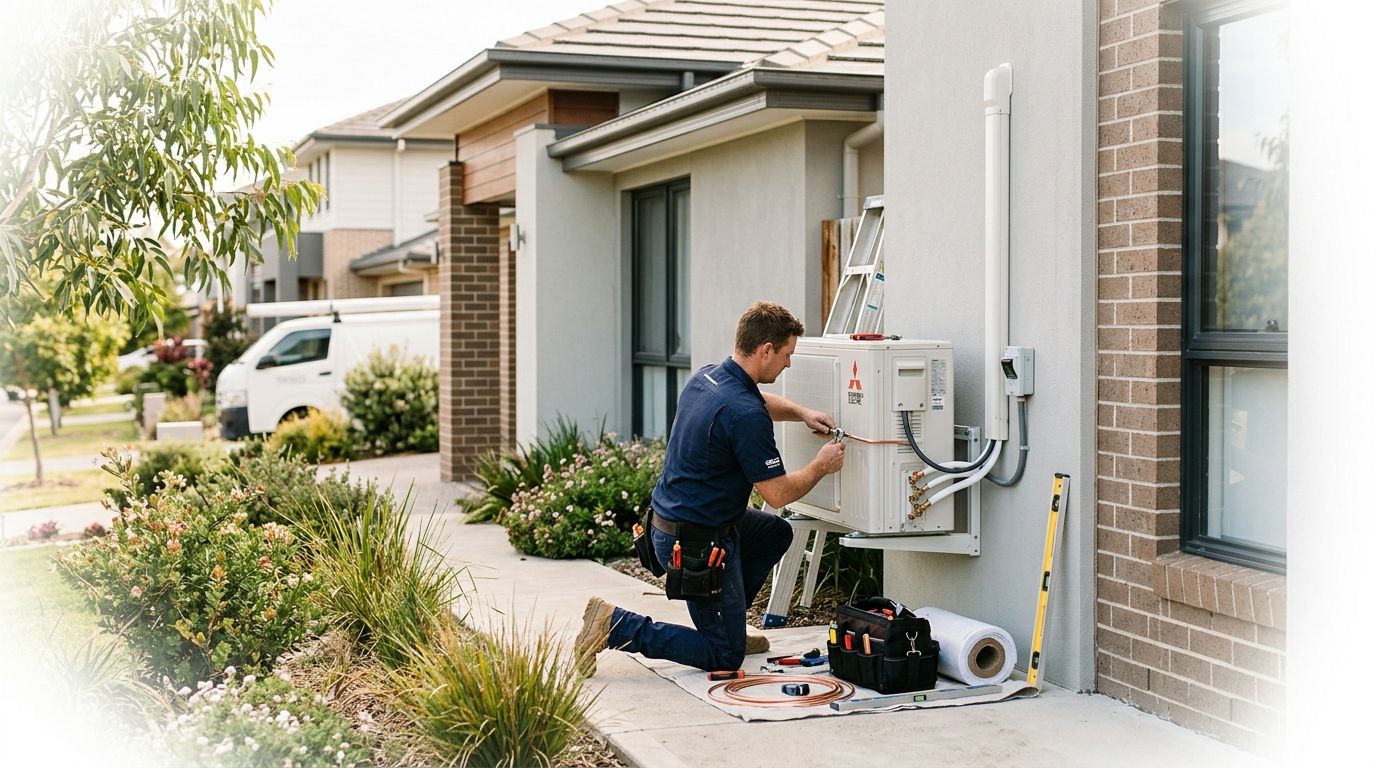
A licensed technician installing a split system aircon will typically complete eight distinct steps, from choosing the right wall position through to commissioning the finished system. Understanding each step makes it clear why the job takes two to four hours even for an experienced installer, and why several of those steps cannot legally be performed by a homeowner.
- Choose the location for the indoor unit. The indoor unit should be mounted high on an exterior wall, away from direct sunlight, heat sources like ovens or lamps, and obstructions that would block airflow. Most manufacturers specify a minimum clearance of 15–20cm above the unit and at least 2–3m of clear space in front of it. The wrong location will reduce efficiency and can cause the unit to short-cycle.
- Mount the backing plate and drill the wall penetration hole. The installer fixes the mounting bracket to the wall using a spirit level to ensure it is perfectly horizontal. A core hole is then drilled through the wall at a slight downward angle toward the outside so that condensate drains away from the building rather than pooling inside the wall cavity.
- Feed the line set and cables through the wall. The refrigerant lines (pre-insulated copper tubing), the electrical interconnecting cable and the condensate drain pipe are bundled together and fed through the core hole. The bundle is typically wrapped in a protective conduit or line cover on the exterior wall.
- Mount and connect the indoor unit. The indoor unit clips onto the backing plate and the refrigerant lines, drain pipe and electrical cable are connected to the unit's service ports and terminals. The installer checks that the drain pipe has a continuous fall toward the outlet so water cannot pool.
- Position and secure the outdoor unit. The outdoor unit (compressor) is placed on a flat, stable concrete pad or a purpose-built wall bracket, with adequate clearance on all sides for airflow and future servicing. Siting the compressor correctly has a real impact on efficiency and noise levels. For detailed guidance on this step, see our guide on where to place your outdoor unit.
- Connect the refrigerant lines, electrical wiring and drain line to the outdoor unit. The flare fittings on the refrigerant lines are torqued to the manufacturer's specification using a torque wrench. The electrical connections are made at the outdoor unit's terminal block, and the drain line is directed to a suitable discharge point.
- Pressure-test and vacuum the refrigerant lines. Before any refrigerant is released into the system, the installer pressure-tests the line set with nitrogen to check for leaks. The lines are then evacuated using a vacuum pump to remove all moisture and air. This step is critical. Moisture left in the system will react with refrigerant to form acids that corrode the compressor from the inside.
- Commission the system. With the lines evacuated, the refrigerant valve is opened and the system is powered up. The technician checks the refrigerant charge (adding or recovering refrigerant as needed), runs a full test cycle in both cooling and heating modes, and verifies that airflow, temperatures and pressures are all within specification.
Steps 6, 7 and 8 are legally restricted to licensed tradespeople in Australia. Connecting refrigerant lines and handling refrigerant requires an ARC licence, and the electrical connections at the outdoor unit must be made by a licensed electrician. These are not guidelines or recommendations. They are legal requirements under federal and state law.
What You Can Do Yourself (and What You Absolutely Cannot)
Australian homeowners can legally handle a small number of tasks in a split system installation, but the core work must be done by licensed tradespeople. Knowing exactly where that line sits will help you have a more informed conversation with your installer and avoid any costly mistakes.
Tasks a Homeowner Can Legally Handle
None of the following tasks require a trade licence, and a competent DIYer can take care of them without any legal risk:
- Choosing the installation location. Deciding where the indoor and outdoor units will go is entirely your call. Walk through the step-by-step section above and think about wall space, clearances, sun exposure and where the line set will run.
- Clearing the area and preparing the wall surface. Moving furniture, removing wall art and making sure the installer has clear access to both the indoor and outdoor locations will save time on the day and may reduce your labour bill.
- Purchasing the unit in advance. Buying your unit separately before booking an installer is one of the most effective ways to control costs. Installers who supply the unit themselves typically mark it up. Sourcing your own unit from a retailer like AusAir Conditioners means you pay the retail price, not a trade margin. Browse our full range of split system air conditioners to compare models and prices before you call an installer.
- Ongoing filter maintenance. Once the system is installed, cleaning the filters every four to six weeks is a legitimate and important DIY task. Our guide to cleaning your AC filter covers exactly how to do it and how often.
Tasks That Must Be Done by a Licensed Professional
The following tasks are legally restricted in Australia and cannot be performed by an unlicensed homeowner, regardless of skill level:
- All refrigerant handling. Connecting refrigerant lines, pressure-testing, vacuuming and charging the system all involve refrigerant and require an ARC (Refrigerant Handling Licence) issued by the Australian Refrigeration Council. This applies even if you are not directly touching the refrigerant itself.
- All electrical connections to the mains or switchboard. Running the dedicated circuit from your switchboard, installing the isolator switch near the outdoor unit and making the final electrical connections all constitute licensed electrical work. Every Australian state and territory requires a licensed electrician for this work.
- Pressure testing and commissioning. These steps are inseparable from refrigerant handling and must be completed by the same ARC-licensed technician.
Attempting any of these tasks without the appropriate licence is illegal under federal and state law. Beyond the legal risk, unlicensed installation will void the manufacturer's warranty on your unit and is very likely to invalidate your home and contents insurance if a fault or fire results from the work. The consequences are serious and the savings are not worth it.
Most professional installation quotes already include the structural preparation tasks listed above. Separating them out and doing them yourself rarely saves meaningful money, since the labour cost is bundled into the overall job rather than itemised separately.
How Much Does Professional Split System Installation Cost in Australia?
Professional split system installation in Australia typically costs between $600 and $1,200 for a standard single-storey home, not including the unit itself. Add the cost of the unit and most homeowners are looking at a total installed price of $1,600 to $2,500 for a bedroom or living room system, depending on the brand, capacity and complexity of the job.
To put that in concrete terms, here are three popular units and what you might expect to pay for the hardware alone before installation labour is added:
- Daikin Cora 3.5kW Inverter Split System (FTXV35WVMA) — $1,256. A solid mid-range choice for a medium-sized bedroom or home office.
- Mitsubishi Electric AP Series 2.5kW Split System (MSZ-AP25VGKD) — $1,035. A reliable entry-level option well suited to smaller bedrooms.
- Fujitsu Lifestyle 2.5kW Inverter Split System (ASTG09KMTC) — $1,014. Another compact 2.5kW option with a competitive price point for smaller spaces.
Add $600 to $900 in labour for a straightforward single-storey installation and you get a realistic total budget for each of these units. The labour figure is where things can shift considerably depending on your specific situation.
Several factors push installation costs toward the higher end of the range or beyond it:
- Double-storey homes. Running the line set between floors adds time and materials, and working at height may require additional equipment. Expect to add $200 to $400 to a standard quote.
- Long pipe runs. If the outdoor unit needs to be sited more than five or six metres from the indoor unit, the installer will need additional refrigerant line set and conduit. Each extra metre adds cost.
- Difficult wall materials. Drilling through brick or double brick walls takes significantly longer than timber-framed walls and puts more wear on equipment. Some installers charge a specific surcharge for masonry penetrations.
- Switchboard upgrades. If your switchboard does not have a spare circuit breaker slot, or if it is an older fuse-based board, the electrician may need to upgrade it before the dedicated circuit can be installed. This can add $300 to $800 or more to the total cost.
Prices also vary by state. Labour rates in Sydney and Melbourne tend to run higher than in regional areas, and some states have specific licensing requirements that affect how the electrical work is quoted and invoiced.
For a full breakdown of what drives installation costs, including how to compare quotes and what to watch out for, see our 2026 air conditioning installation cost guide.
Ready to Buy Your Split System? Here's How to Get Started
Installing a split system is not a job you can legally do yourself in Australia, but that does not mean you have no control over the cost. Sourcing your unit separately from a retailer and having a licensed installer fit it is one of the most effective ways to keep the total price down, since you pay the retail price on the hardware rather than a trade margin.
If you already know the capacity you need, browse our full range of split system air conditioners to compare models, brands and prices before you start calling installers. Having a specific unit in mind also makes it easier to get accurate, like-for-like quotes from multiple tradespeople.
Not sure what size unit your room needs? Our room-by-room sizing guide will help you work out the right capacity before you buy.
Frequently Asked Questions
Can I install a split system air conditioner myself?
You cannot legally complete a full split system air conditioner installation yourself in Australia. Handling refrigerant requires an ARC (Australian Refrigeration Council) licence, and all electrical connections must be carried out by a licensed electrician. Homeowners can choose a location or clear the area beforehand, but the core installation work is restricted by law.
What is the $5000 AC rule?
The '$5,000 AC rule' refers to a provision in some Australian states, notably Queensland, that previously allowed homeowners to self-install certain low-voltage air conditioning equipment under a specific dollar threshold. This rule is widely misunderstood and does not override the requirement for a licensed electrician or ARC-licensed technician for refrigerant work. Regardless of unit cost, refrigerant handling and mains electrical connections always require licensed tradespeople. Check with your state's electrical safety regulator for the current rules in your area.
Can I install my own split AC?
You cannot legally install your own split AC in Australia without the appropriate licences. Refrigerant handling and electrical connections are restricted to licensed tradespeople, while preparatory tasks like choosing a wall position are fine for homeowners. Attempting unlicensed work can void your manufacturer warranty and may affect your home insurance coverage if something goes wrong.
Do I need an electrician to install a split system?
Yes, a licensed electrician is required for all electrical connections in a split system installation, including wiring the indoor and outdoor units and connecting the system to your switchboard or a dedicated circuit. Many air conditioning installers hold both an ARC licence and an electrical licence, so one tradesperson can handle the full job. Confirm your installer's credentials before booking to make sure they are qualified for both.