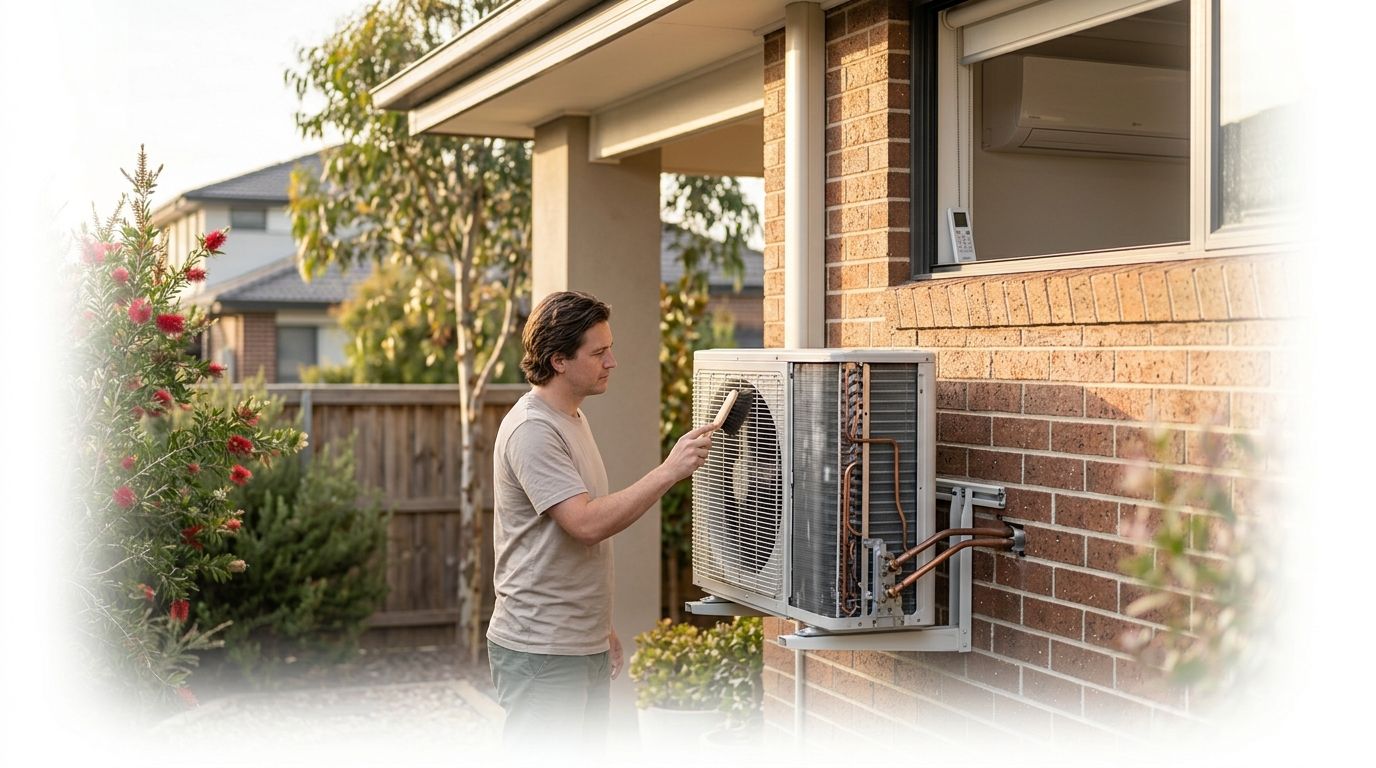

How Does Air Conditioning Work? The Short Answer
Air conditioning works by moving heat out of your home rather than generating cold air from scratch. A refrigerant fluid circulates continuously through your system, absorbing heat from your indoor air and releasing it outside. The result is a cooler, more comfortable room. This guide walks through the refrigeration cycle, the key components inside your unit, and how modern reverse-cycle systems handle both cooling and heating.
Understanding the basics helps you choose the right system, troubleshoot problems early and get more out of your investment. You do not need an engineering degree to follow along. The core idea is simple: heat moves, and your air conditioner is the pump that moves it.
Key takeaways
- Air conditioning works by moving heat out of your home using a refrigerant that circulates continuously.
- The vapour-compression refrigeration cycle is the engine behind every air conditioner.
- Reverse-cycle systems provide both cooling and heating with impressive energy efficiency.
The Refrigeration Cycle: The Engine Behind Every Air Conditioner
Every air conditioner, from a compact wall-mounted split system to a whole-home ducted unit, runs on the same fundamental process: the vapour-compression refrigeration cycle. It is a continuous loop that pumps heat from inside your home to the outside, stage by stage, using a refrigerant as the working fluid. There is no magic involved, just physics.
Here is how the cycle works, step by step.
- Heat absorption at the evaporator coil. The refrigerant enters the indoor unit as a cold, low-pressure liquid. Warm air from your room is drawn across the evaporator coil, and the refrigerant absorbs that heat energy. As it does, the refrigerant evaporates and turns into a gas. Your room air, now stripped of much of its heat, is blown back into the room as cool air.
- Compression. The refrigerant gas travels to the compressor, which sits in the outdoor unit. The compressor squeezes the gas under high pressure, which raises its temperature significantly. At this point the refrigerant is a hot, high-pressure gas.
- Heat release at the condenser coil. The hot gas moves through the condenser coil in the outdoor unit. A fan blows outside air across the coil, and the refrigerant releases its heat into that outside air. As it loses heat, the refrigerant condenses back into a liquid. This is how your air conditioner physically dumps your home's heat outdoors.
- Pressure drop at the expansion valve. Before the liquid refrigerant re-enters the indoor unit, it passes through an expansion valve. This rapidly drops the pressure and temperature of the liquid, making it cold again and ready to absorb more heat. The cycle then repeats continuously for as long as the system is running.
The key takeaway is that this is a closed loop. Heat is constantly being extracted from your indoor air and expelled outside. Your air conditioner is not producing cold, it is removing heat.
The Four Key Components and What They Do
Each stage of the refrigeration cycle depends on one of four core components. Here is where each one lives and what it does.
| Component | Location | Role in the Cycle |
|---|---|---|
| Evaporator coil | Indoor unit | Absorbs heat from your room air, causing the refrigerant to evaporate into a gas |
| Compressor | Outdoor unit | Pressurises the refrigerant gas, raising its temperature so it can release heat outside |
| Condenser coil | Outdoor unit | Releases the absorbed heat into the outside air, condensing the refrigerant back into a liquid |
| Expansion valve | Between outdoor and indoor units | Drops the pressure and temperature of the liquid refrigerant, resetting it to absorb heat again |
The refrigerant is the fluid that carries heat through all four of these components. Older systems used refrigerants like R-22, but modern Australian units have largely moved to R-32, which has a lower global warming potential and is more energy efficient. Some newer systems use R-410A or R-454B depending on the manufacturer and model.
For a full breakdown of refrigerant types, what they cost to recharge and how to check what your system uses, see our guide to air conditioning refrigerant types and costs.

Cooling Mode vs Heating Mode: How Reverse Cycle Works
A reverse cycle air conditioner is a split system that can run the refrigeration cycle in both directions, cooling your home in summer and heating it in winter using the same unit. In cooling mode, heat is absorbed indoors and expelled outside. In heating mode, a reversing valve switches the direction of refrigerant flow so the roles of the coils swap. The outdoor coil absorbs heat from the outside air and the indoor coil releases that heat into your room. For a deeper look at how this works, see our article on what is a reverse cycle air conditioner and how does it work.
The clever part is that this process works even on cold days. Outside air at 5 or 6 degrees Celsius still contains usable heat energy, and the refrigerant is cold enough to absorb it. This is why reverse cycle heating is so efficient: the system is moving heat rather than generating it from scratch, the way a resistive electric heater does.
In practical terms, a reverse cycle system typically delivers two to four units of heat energy for every one unit of electricity it consumes. That ratio, known as the coefficient of performance, is what makes reverse cycle one of the most cost-effective heating options available to Australian homeowners, particularly in temperate climates like Sydney, Melbourne and Adelaide.
Most modern reverse cycle units also include inverter technology, which allows the compressor to vary its speed continuously rather than simply switching on and off at full power. The compressor ramps up quickly to reach your target temperature, then slows down to maintain it, using only as much energy as the room actually needs. Older fixed-speed compressors could not do this, which is why they consumed significantly more electricity. To understand exactly how this works, our guide on what is an inverter air conditioner covers the detail.
Two popular examples of modern inverter reverse cycle split systems available at AusAir Conditioners are the Daikin 3.5kW Cora Inverter Split System (FTXV35WVMA) at $1,287 and the Fujitsu 2.5kW Lifestyle Range Inverter Split System (ASTG09KMTC) at $1,037. The Daikin Cora suits most standard bedrooms and living areas, while the Fujitsu Lifestyle is a compact, entry-level option well suited to smaller rooms or apartments.
The Different Types of Air Conditioning Systems and How They Differ
All air conditioning systems use the same refrigeration cycle described above, but the way they distribute conditioned air around a home varies considerably. The right system type depends on how many rooms you need to cool or heat, your budget and whether you are retrofitting an existing home or building new. Here is a straightforward comparison of the four main types you will encounter in Australia.
| System Type | Best For | Typical Price Range | Key Advantage |
|---|---|---|---|
| Split system | Single rooms or open-plan living areas | $700 to $2,500 (supply only) | Affordable, efficient and easy to install in most homes |
| Ducted system | Whole-home climate control across multiple rooms | $5,000 to $15,000+ installed | Discreet, consistent temperature throughout the entire home |
| Multi-head split system | Multiple rooms without ducting | $3,000 to $8,000+ installed | Independent temperature control per room from one outdoor unit |
| Portable or window unit | Renters or rooms where wall installation is not possible | $400 to $1,200 | No installation required, can be moved between rooms |
Split systems are by far the most popular choice for Australian homeowners. A single outdoor unit connects to a single indoor wall-mounted unit, making installation straightforward and relatively affordable. The Daikin 3.5kW ALIRA X Inverter Split System (FTXM35AVMA) at $1,447 is a good example of a mid-range split system with built-in WiFi, letting you control temperature from your phone before you even get home.
Ducted systems suit larger homes where you want whole-home climate control without visible indoor units in every room. The trade-off is cost. Ducted systems require significant installation work, particularly in existing homes where ductwork needs to be run through the ceiling cavity. They are most cost-effective when installed during a new build or major renovation.
Multi-head split systems sit between the two. One outdoor unit connects to two, three or more indoor units in separate rooms, each with its own controls. You avoid the expense of ducting while still covering multiple zones. Portable and window units contain all components in a single box, which keeps the price low, but they are less efficient than split systems and can be noisy in operation.
For most homeowners looking to cool or heat one or two rooms, a split system is the practical starting point. Browse our full range of split system air conditioners to compare brands, capacities and price points side by side.
Ready to Choose the Right System for Your Home?
Air conditioners do not create cold air. They move heat out of your home using a continuous refrigeration cycle, and modern reverse-cycle inverter systems do this in both directions with impressive efficiency. Understanding that core idea puts you in a much stronger position as a buyer. You know what to look for, what the specs actually mean and how to keep your system running well once it is installed.
If you are ready to compare options, browse our full range of split system air conditioners to find the right brand, capacity and price point for your home. We stock all the major brands with competitive pricing and nationwide delivery.
Not sure what capacity you need before you buy? Our guide on what size air conditioner do I need walks you through the calculation step by step so you do not end up with a unit that is too small to cope or too large for the room.
Frequently Asked Questions
How does an air conditioner work in simple terms?
An air conditioner works by moving heat out of your home rather than creating cold air from scratch. Refrigerant circulates through the system, absorbing heat from the air inside your room, carrying it to the outdoor unit and releasing it outside. The result is that the air left behind feels cooler.
What is the 3 minute rule for air conditioners?
The 3-minute rule means waiting at least three minutes before restarting your air conditioner after switching it off. The compressor needs time to equalise refrigerant pressure, and restarting too quickly forces it to work against high pressure, which can cause serious damage over time. Most modern units have a built-in time-delay protection circuit that handles this automatically, but it is still a good habit to follow if you are cycling the unit manually.
How does AC make a room cool?
AC makes a room cool by drawing warm air over a very cold evaporator coil inside the indoor unit. As refrigerant evaporates inside that coil, it absorbs heat from the passing air, and a fan blows the now-cooler air back into the room. As a bonus, moisture in the air condenses on the cold coil and drains away, which is why running your air conditioner also reduces humidity.
Do AC units use a lot of electricity?
AC units are actually among the most efficient ways to heat or cool a home. A typical 3.5kW reverse-cycle inverter split system produces around 3 to 4 kWh of heating or cooling for every 1 kWh of electricity it consumes, making it far more efficient than a bar heater or fan heater that converts electricity to heat at a one-to-one ratio. Your actual running costs depend on the unit's star rating, the size of the room and how many hours it runs each day. For a full breakdown of what to expect on your power bill, see our guide to how much power an air conditioner uses.