
What Is a Reverse Cycle Air Conditioner?
A reverse cycle air conditioner is a single unit that both cools your home in summer and heats it in winter. Unlike a standard cooling-only air conditioner, it can reverse the direction of its refrigeration cycle to either remove heat from your home or bring heat into it. The result is one system that handles year-round climate control without needing a separate heater.
The vast majority of split systems and ducted systems sold in Australia today are reverse cycle. It has become the default technology in the market, and for good reason: it is efficient, versatile and well-suited to Australia's wide range of climates, from the humid summers of Queensland to the cold winters of Victoria and Tasmania.
This article covers how the refrigeration cycle actually works in plain language, the real advantages and limitations of reverse cycle technology, and how to choose the right system for your home.
Key takeaways
- A reverse cycle air conditioner heats and cools your home using a single efficient system.
- The technology moves heat rather than generating it, delivering three to five units of heating for every unit of electricity consumed.
- Reverse cycle systems are now the standard choice across Australian homes and climates.
How Does a Reverse Cycle Air Conditioner Work?
A reverse cycle air conditioner works by moving heat from one place to another using a refrigerant, rather than generating heat directly. In cooling mode it pulls heat out of your room and dumps it outside. In heating mode it does the opposite, extracting heat energy from outside air and releasing it indoors. Because the system is transferring heat rather than creating it, it is far more efficient than a resistive electric heater, which simply converts electricity into warmth at a one-to-one ratio.
The four key stages of the cycle are: the compressor pressurises the refrigerant gas, the indoor coil either absorbs or releases heat depending on the mode, the outdoor coil does the opposite job, and the refrigerant continuously shifts between liquid and gas states as it moves between the two coils, carrying heat energy with it. A reversing valve is the component that switches the direction of refrigerant flow between cooling and heating mode.
Most modern reverse cycle units are also inverter-driven, meaning the compressor adjusts its speed continuously rather than switching on and off at full power. If you want to understand what an inverter air conditioner does and why it matters for running costs, that guide covers it in detail.
Cooling Mode
In cooling mode, the indoor unit draws warm room air across the evaporator coil. The refrigerant inside that coil is at low pressure and cold, so it absorbs the heat from the passing air and evaporates into a gas. The now-cooled air is blown back into the room, dropping the temperature.
The compressor then pressurises the refrigerant gas and sends it to the outdoor condenser coil. A fan blows outside air across this coil, which causes the refrigerant to release its heat to the outdoors and condense back into a liquid. That liquid refrigerant then travels back inside to repeat the cycle. The net effect is that heat is continuously pumped out of your room and expelled outside.
Heating Mode
In heating mode, the reversing valve flips the direction of refrigerant flow. The outdoor coil now acts as the evaporator, absorbing heat energy from the outside air. This surprises many people because it works even on cold days. Outside air still contains usable heat energy at temperatures well below zero, and most quality reverse cycle systems can extract heat from outside air down to around minus 15 degrees Celsius, depending on the model.
The refrigerant carries that extracted heat to the indoor coil, which now acts as the condenser and releases the warmth into your room. Because the system is moving heat rather than generating it from scratch, it can deliver three to five units of heat energy for every one unit of electricity consumed. This ratio is called the coefficient of performance, and it is why reverse cycle heating is significantly cheaper to run than a standard electric bar heater or fan heater.

Reverse Cycle vs Other Heating and Cooling Options
Reverse cycle air conditioning is one of several ways Australian homeowners heat and cool their homes, but it is the only single system that handles both jobs efficiently. The table below compares the most common options across the key factors that matter: running cost, versatility and best use case.
| System Type | Heats? | Cools? | Approx. Running Cost | Best For |
|---|---|---|---|---|
| Reverse Cycle Split System | Yes | Yes | Low to moderate (high efficiency, ~30c/kWh) | Single rooms or open-plan living areas year-round |
| Ducted Reverse Cycle | Yes | Yes | Moderate (higher capacity, but zoning reduces waste) | Whole-home climate control in larger properties |
| Gas Ducted Heating | Yes | No | Low to moderate (gas rates vary by state) | Heating-only in colder southern states with gas connection |
| Evaporative Cooler | No | Yes (dry climates only) | Very low (uses little electricity) | Cooling in low-humidity climates such as inland WA or SA |
| Portable Air Conditioner | Some models | Yes | High (less efficient, single-hose heat leakage) | Renters or temporary cooling where installation is not possible |
Reverse cycle is the only option in this list that heats and cools with genuine energy efficiency. Gas ducted heating is cost-effective in Victoria and South Australia where gas infrastructure is established, but it leaves you without cooling and adds a second system cost if you want both. Evaporative coolers are cheap to run but fail in humid conditions, ruling them out for most of coastal Queensland and New South Wales. Portable units are a last resort rather than a long-term solution.
For whole-home comfort, reverse cycle ducted air conditioners deliver heating and cooling to every room through a single ceiling-mounted system, making them the most practical choice for larger homes. For a deeper breakdown of heating-only systems and how they stack up on running costs, our guide to best heating options for Australian homes covers the full picture.
Pros and Cons of Reverse Cycle Air Conditioning
Reverse cycle air conditioning offers genuine advantages over every other heating and cooling technology available to Australian homeowners, but it is not without trade-offs. Here is an honest look at both sides before you commit to a purchase.
Pros
- Year-round comfort from one system. A single reverse cycle unit replaces both a heater and an air conditioner, reducing the number of appliances you need to buy, install and maintain.
- High energy efficiency. A coefficient of performance (COP) of three to five means you get three to five units of heating or cooling energy for every one unit of electricity consumed. No resistive heater or gas furnace can match that ratio. If you want to calculate what this means for your actual power bill, our guide on how much power an air conditioner uses walks through the maths with real electricity rates.
- No gas line required. Reverse cycle systems run entirely on electricity, which matters in newer suburbs and regional areas where gas infrastructure is limited or being phased out.
- Built-in air filtration. Most modern units include washable filters that capture dust, pollen and airborne particles as air circulates through the indoor unit, improving indoor air quality as a side benefit.
- Effective in cold temperatures. Quality models from brands like Daikin and Mitsubishi Electric can extract heat from outside air down to around minus 15 degrees Celsius, making them reliable through even a Canberra or alpine winter.
Cons
- Higher upfront cost. A quality reverse cycle split system starts at around $1,035 for a compact unit and rises from there. Add professional installation and you are typically looking at $1,500 to $3,000 all up, well above the cost of a portable fan heater or basic pedestal fan.
- Professional installation is required. Refrigerant handling is licensed work in Australia. You cannot legally install a split system yourself, which adds to the total cost and means booking a qualified installer.
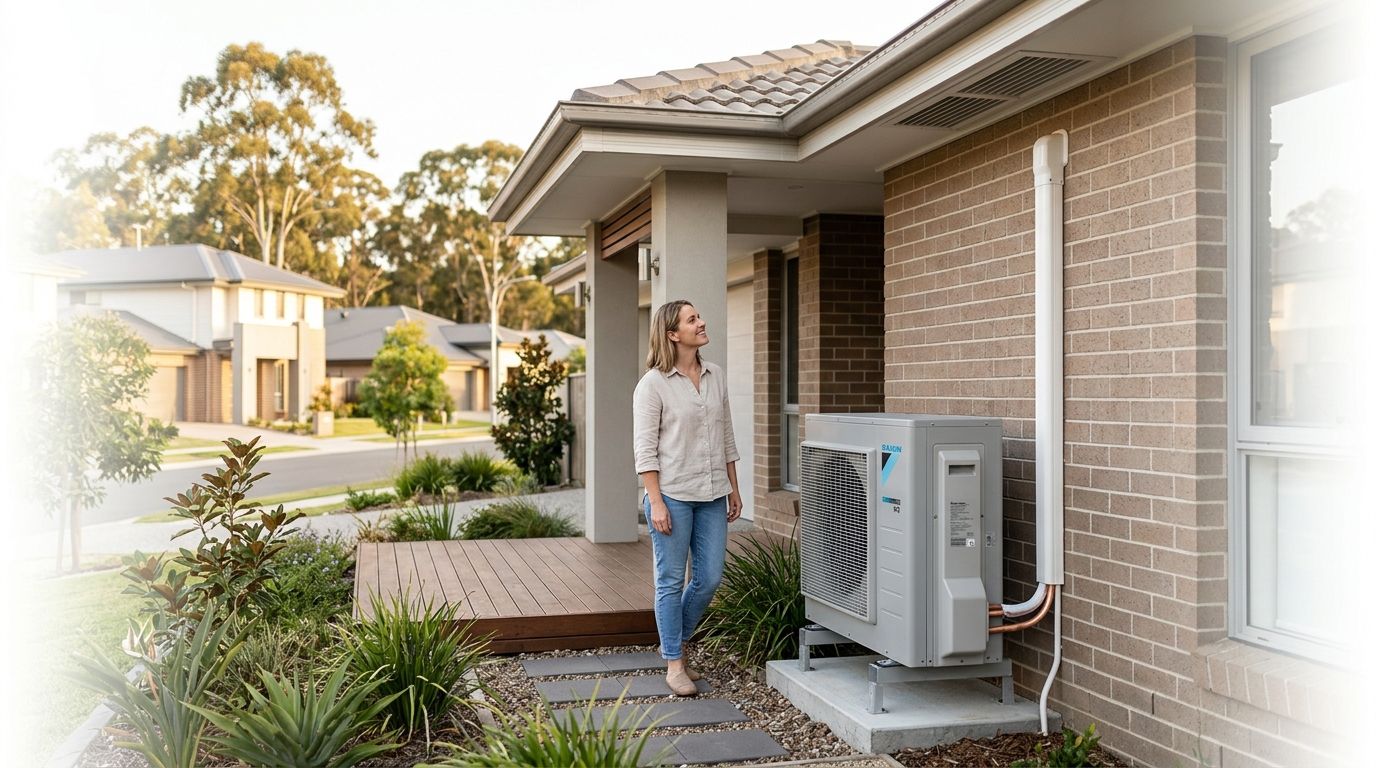
- The outdoor unit needs space and airflow. The compressor unit must be mounted in a location with adequate clearance and ventilation. Tight courtyards, enclosed balconies or body corporate restrictions can complicate installation in apartments and townhouses.
- Performance can drop in extreme heat. Some models lose efficiency or capacity when outside temperatures exceed 46 degrees Celsius. In regions that regularly hit those temperatures, check the manufacturer's rated capacity at high ambient temperatures before buying.
For most Australian homes, the efficiency gains over time more than offset the higher upfront cost. A reverse cycle system running at a COP of four costs roughly a quarter of what an equivalent electric bar heater costs to produce the same warmth. Over a typical system lifespan of 10 to 15 years, that difference adds up to thousands of dollars in savings on electricity bills.
Which Reverse Cycle Air Conditioner Should You Buy?
Choosing the right reverse cycle air conditioner comes down to three things: getting the capacity right for your room size, making sure the unit uses inverter technology and picking a brand with a solid warranty. Get all three right and you will have a system that runs efficiently and reliably for well over a decade.
1. Match Capacity to Your Room Size
Capacity is measured in kilowatts and it is the most common mistake buyers get wrong. Too small and the unit runs flat out without ever reaching your target temperature. Too large and it short-cycles, switching on and off too frequently and wearing out faster than it should.
A practical starting point is 0.06 to 0.07 kW per square metre of floor area. So a 25 square metre bedroom needs roughly 1.5 to 1.75 kW, while a 50 square metre open-plan living area needs around 3 to 3.5 kW. Adjust upward if your ceilings are higher than 2.7 metres, your insulation is poor, you are in a hot climate zone like Queensland or the Northern Territory, or the room gets heavy afternoon sun. Adjust downward slightly for well-insulated, south-facing rooms in cooler southern states.
2. Choose an Inverter Model
All three products mentioned below are inverter-driven, and that is not a coincidence. Inverter technology allows the compressor to vary its speed rather than switching on and off at full power, which cuts running costs significantly and keeps the room temperature more stable. Non-inverter units are rare in the Australian market now, but if you ever see a unit without 'inverter' in the description, avoid it.
3. Consider Brand Reliability and Warranty
Daikin and Mitsubishi Electric are consistently the two most recommended brands by Australian installers, and both back their products with strong warranties. Daikin offers a five-year parts and labour warranty on most residential split systems. Mitsubishi Electric offers a five-year warranty on parts. Both brands have wide service networks across Australia, which matters if you ever need a technician.
Three Products Across Different Price Points
For a smaller room up to around 25 square metres, the Mitsubishi Electric 2.5kW AP Series Split System (MSZAP25VGKD) at $1,035 is a compact and affordable entry point. It is a no-fuss reverse cycle unit that does the job reliably without unnecessary extras.
For a medium-sized bedroom or living area, the Daikin 3.5kW Cora Inverter Split System (FTXV35WVMA) at $1,287 is one of the most popular units in Australia for good reason. It is quiet, efficient and straightforward to operate, making it a solid all-rounder at an accessible price.
If you want smart home control and a step up in features without going premium, the Daikin 3.5kW ALIRA X Inverter Split System (FTXM35AVMA) at $1,447 adds built-in WiFi so you can control the unit from your phone. That extra $160 over the Cora buys you app control and a slightly more refined design.
Browse the full range of split system air conditioners to compare capacity options, brands and prices across the complete AusAir catalogue.
FAQ: Reverse Cycle Air Conditioners
Is a reverse cycle air conditioner the same as a heat pump?
Yes, a reverse cycle air conditioner is a type of heat pump. Both terms describe the same underlying technology: a system that moves heat from one place to another using a refrigerant cycle rather than generating heat directly. In Australia, the term 'reverse cycle' is more commonly used in the residential air conditioning market, while 'heat pump' is more often used in the context of hot water systems and commercial HVAC.
Can a reverse cycle air conditioner heat a room in very cold weather?
Yes. Most quality reverse cycle systems can extract usable heat from outside air down to around minus 15 degrees Celsius, which covers the coldest nights experienced in most Australian cities including Canberra and alpine Victoria. Performance does reduce at very low temperatures, so if you live in an area that regularly drops below minus 10 degrees, check the manufacturer's rated heating capacity at low ambient temperatures before buying.
How much does it cost to run a reverse cycle air conditioner?
Running costs depend on the unit's capacity, its energy star rating and your local electricity tariff. As a rough guide, a 3.5kW reverse cycle split system running at a coefficient of performance of four will consume around 0.875 kWh of electricity to deliver 3.5 kWh of heating. At around 30 cents per kWh, that works out to roughly 26 cents per hour of heating. Cooling costs are similar, though the COP varies by model and conditions.
Do I need a separate heater if I have a reverse cycle air conditioner?
No. A reverse cycle air conditioner handles both heating and cooling from a single unit, so there is no need for a separate heater in most Australian homes. The only exception might be an extremely cold alpine region where temperatures regularly fall below the unit's rated operating range, though this is uncommon for most residential locations across the country.
Ready to Find the Right Reverse Cycle System for Your Home?
Reverse cycle air conditioners are the most versatile and energy-efficient way to heat and cool an Australian home. They work by moving heat rather than generating it, which is why a quality inverter model can deliver three to five units of warmth for every one unit of electricity consumed. Modern units are quieter, smarter and cheaper to run than ever, making them the obvious choice for year-round comfort across every Australian climate.
Match the capacity to your room size, choose an inverter model from a reputable brand and factor in the full installed cost rather than just the unit price. Whether you are cooling a small bedroom or heating a large open-plan living area, there is a reverse cycle split system that fits your space and your budget.
Browse the full AusAir range to compare models, capacities and prices, or get in touch with our team for personalised advice on the right system for your home.